

Now that you’ve completed your Activity Log, are you surprised by where your time goes?
It’s amazing to learn what we really do over the course of a day. This powerful exercise is often the turning point for people who struggle with time management. Knowing how long you spend on tasks enables you to start taking control with solid planning.
How well do you think you estimated your time usage? Let’s find out.
Action:
Gather up your Activity Log sheets for the week. Calculate the total amount of time you accounted for, and record the percentage you spent on each activity in the “actual time spent” column.. Then, answer the questions below.
1. What have you learned about the way you spend your time?
2. Were your estimates accurate? If not, why do you think this is?
3. What surprised you the most?
Is Your Time Well Spent?
So far, you’ve identified what you’re really spending your time on, and you’ve categorized your tasks to show whether they are high, medium or low value. Next, we’ll identify where your real priorities lie. This will help you determine which actions you should keep doing, which you should do more of, and which you should stop doing.
The purpose of a time management audit is to allocate your available hours more effectively. To do this, you need to identify which activities are high priority and which are not, and this is where the Action Priority Matrix is useful.
You can use this tool (see Figure 1, below) to put each of your tasks into one of four categories, based on its impact and how much effort it requires.
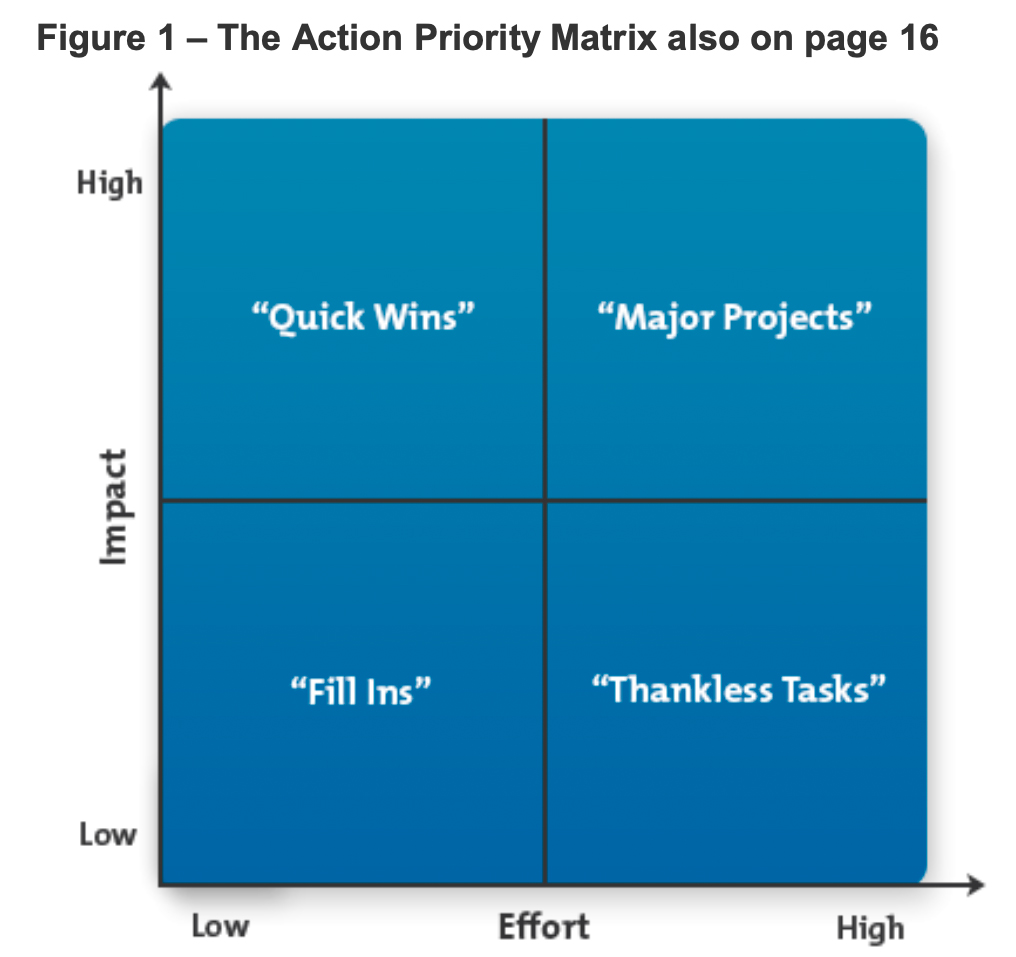 Figure 1: Action Priority Matrix
Quick Wins
These are tasks that return high value for the time and effort you put in. The more “quick wins” you can accomplish, the better.
Major Projects
These are high impact, high effort, time consuming projects. It’s easy to let these monopolize your schedule, so you need to make sure that you’re using your time efficiently.
Fill ins
These are the low impact, low effort tasks that you should complete in any time that’s spare. If you don’t have any capacity, these just don’t have to get done!
Thankless Tasks
These are the activities that give meaning to the phrase “work smarter, not harder.” If you are spending lots of time and effort on something that will give you a low return, there is no reason to continue. Either drop the task, allocate it to someone who can do it quicker (a Specialist), or delegate it to a more junior team member.
Action:
Determine the position of each of the activities that you identified on the Action Priority Matrix, and record them on below In the “present” column, include an approximate percentage of time you spend on each.
Action Priority Matrix Worksheet (PDF)
Action:
Take a moment to think about how efficiently you are currently allocating your time. Are there “thankless tasks” that you can delegate or drop? Are you spending too much time on “fill ins”? In the “proposed” column for each activity, indicate whether you will:
- Drop the item.
- Delegate it.
- Decrease the time spent – give a new time percentage.
- Increase the time spent – give a new time percentage.
This is the start of your new time-management plan. You’ll find it much easier to organize your day now that you have a big-picture idea of how to allocate the hours you have available.