

Avoiding Common Pitfalls
How well do you manage your time? If you’re like many people, your answer may not be completely positive! Perhaps you feel overloaded, and you often have to work late to hit your deadlines. Or maybe your days seem to go from one crisis to another, and this is stressful and demoralizing.
Many of us know that we could be managing our time more effectively; but it can be difficult to identify the mistakes that we’re making, and to know how we could improve. When we do manage our time well, however, we’re exceptionally productive at work, and our stress levels drop. We can devote time to the interesting, high-reward projects that can make a real difference to a career. In short, we’re happier!
In this article, we’re looking at ten of the most common time management mistakes, as well as identifying strategies and tips that you can use to overcome them. These ten mistakes are:
Mistake #1 Failing to Keep a To-Do List
Do you ever have that nagging feeling that you’ve forgotten to do an important piece of work? If so, you probably don’t use a To-Do List to keep on top of things. (Or, if you do, you might not be using it effectively!)
The trick with using To-Do Lists Add to My Personal Learning Plan effectively lies in prioritizing the tasks on your list. Many people use an A – F coding system (A for high priority items, F for very low priorities). Alternatively, you can simplify this by using A through D, or by using numbers.
If you have large projects on your list, then, unless you’re careful, the entries for these can be vague and ineffective. For instance, you may have written down “Start on budget proposal.” But what does this entail? The lack of specifics here might cause you to procrastinate, or miss key steps. So make sure that you break large tasks or projects down into specific, actionable steps – then you won’t overlook something important.
Mistake #2 Not Setting Personal Goals
Do you know where you’d like to be in six months? What about this time next year, or even 10 years from now? If not, it’s time to set some personal goals!
Personal goal setting is essential to managing your time well, because goals give you a destination and vision to work toward. When you know where you want to go, you can manage your priorities, time, and resources to get there. Goals also help you decide what’s worth spending your time on, and what just a distraction is.
To learn how to set SMART, effective goals, read up on Locke’s Goal Setting Theory. You’ll learn how to set clearly defined goals that will keep you motivated.
You might also enjoy our Book Insight into Long Fuse, Big Bang Add to by Eric Haseltine. This book teaches you how to focus on your long-term goals without overlooking your short term priorities.
Mistake #3 Not Prioritizing
Your assistant has just walked in with a crisis that she needs you to deal with right now, but you’re in the middle of brainstorming ideas for a new client. You’re sure that you’ve almost come up with a brilliant idea for their marketing campaign, but now you risk losing the thread of your thinking because of this “emergency.”
Sometimes, it’s hard to know how to prioritize especially when you’re facing a flood of seemingly-urgent tasks. However, it’s essential to learn how to prioritize tasks effectively if you want to manage your time better.
One tool that will help you prioritize effectively is the Action Priority Matrix (Figure 1 ) which will help you determine if a task is high-yield and high-priority, or low-value, “fill in” work. You’ll manage your time much better during the day if you know the difference.
Figure 1 – The Action Priority Matrix also on page 16
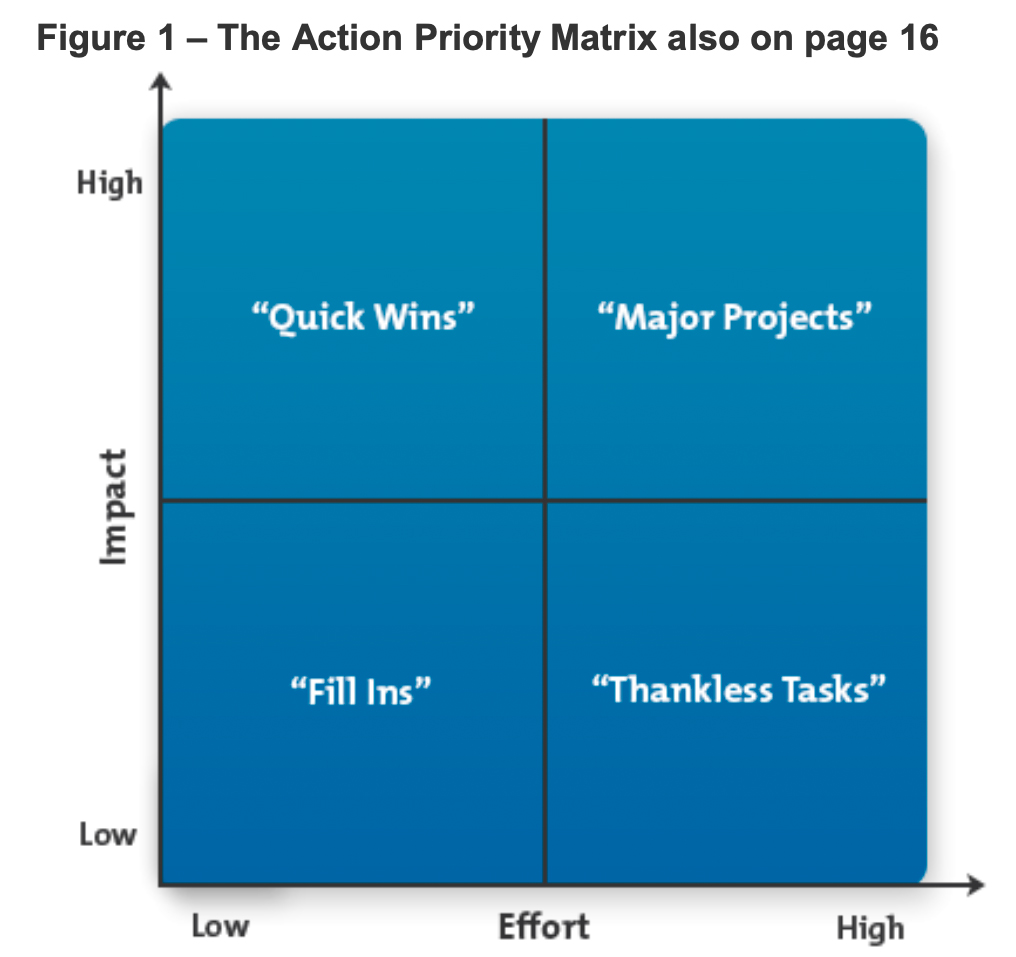
To use the matrix, you score tasks based firstly on their impact and secondly on the effort needed to complete them.
You then use your scores to plot these activities in one of four quadrants:
Quick Wins (High Impact, Low Effort)
Quick wins are the most attractive projects, because they give you a good return for relatively little effort. Focus on these as much as you can.
Major Projects (High Impact, High Effort)
Major projects give good returns, but they are time-consuming. This means that one major project can “crowd out” many quick wins.
Fill Ins (Low Impact, Low Effort)
Don’t worry too much about doing these activities – if you have spare time, do them, but drop them or delegate them if something better comes along.
Thankless Tasks (Low Impact, High Effort)
Try to avoid these activities. Not only do they give little return, they also soak up time that you should be using on quick wins.
Tip: Once you understand the principles behind the Action Priority Matrix, you’ll probably find that you apply it quickly and intuitively to new tasks and projects.